It is the branch of engineering concerned with the design and operation of industrial chemical plants.It is based on the practice of scientific facts to convert raw materials into publicly helpful materials.

Combination of Engineering Knowledge with Engineering Disciplines

Developing the methods to arrest the damages due to failure of equipments during thier service,by using knowledge of Enginering Materials.

Purification of Water by Chemical treatment techniques

Water purification by using economical and environment friendly mthods.

Cement Industry

Introduction to cement industry with some description on process conditions and process controle.

Soap Industry as a part of Chemical Process Industries

Description of process condition and process controle parameters.

Student oriented

We helps to make the website contents as simple as possible to facilitate

Wednesday, 17 January 2018

UV-Vis Spectroscopy- Introduction

***Introduction***

UV radiation and Electronic Excitations

The difference in energy between molecular bonding, non-bonding and anti-bonding orbitals ranges from 125-650 kJ/mole. This energy corresponds to EM radiation in the ultraviolet (UV) region, 100-350 nm, and visible (VIS) regions 350-700 nm of the spectrum.

Process

Using IR we observed vibrational transitions with energies of 8-40 kJ/mol at wavelengths of 2500-15,000 nm. For purposes of our discussion, we will refer to UV and VIS spectroscopy as UV.
In UV spectroscopy, the sample is irradiated with the broad spectrum of the UV radiation. If a particular electronic transition matches the energy of a certain bandof UV, it will be absorbed. The remaining UV light passes through the sample and is observed. From this residual radiation a spectrum is obtained with “gaps” at these discrete energies – this is called an absorption spectrum

Observed electronic transitions

The lowest energy transition (and most often obs. by UV) is typically that of an electron in the Highest Occupied Molecular Orbital (HOMO) to the Lowest Unoccupied Molecular Orbital (LUMO). For any bond (pair of electrons) in a molecule, the molecular orbitals are a mixture of the two contributing atomic orbitals; for every bonding orbital “created”from this mixing (s, p), there is a corresponding anti-bonding orbital of symmetrically higher energy (s*, p*). The lowest energy occupied orbitals are typically the s; likewise, the corresponding anti-bonding s*orbital is of the highest energy. p-orbitals are of somewhat higher energy, and their complementary anti-bonding orbital somewhat lower in energy than s*. Unshared pairs lie at the energy of the original atomic orbital, most often this energy is higher than por s(since no bond is formed, there is no benefit in energy)

Although the UV spectrum extends below 100 nm (high energy), oxygen in the atmosphere is not transparent below 200 nm .Special equipment to study vacuumor far UVis required .Routine organic UV spectra are typically collected from 200-700 nm. This limits the transitions that can be observed:


Selection Rules


  1. Not all transitions that are possible are observed
  2. For an electron to transition, certain quantum mechanical constraints apply –these are called “selection rules”
  3. For example, an electron cannot change its spin quantum number during a transition –these are “forbidden”
  4. Other examples include:
  • the number of electrons that can be excited at one time
  • symmetry properties of the molecule
  • symmetry of the electronic state
To further complicate matters, “forbidden”transitions are sometimes observed (albeit at low intensity) due to other factors

Band Structure

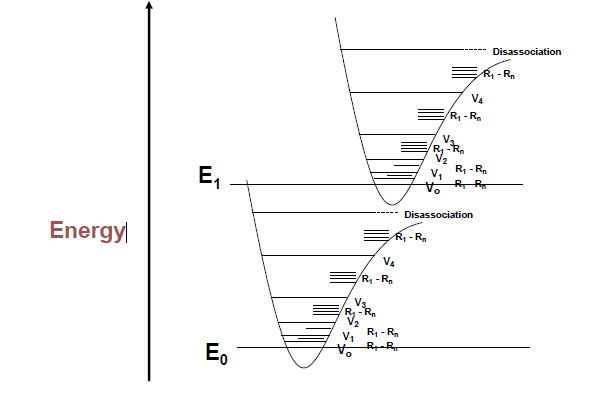
Unlike IR (or later NMR), where there may be upwards of 5 or more resolvable peaks from which to elucidate structural information, UV tends to give wide, overlapping bands. It would seem that since the electronic energy levels of a pure sample of molecules would be quantized, fine, discrete bands would be observed –for atomic spectra, this is the case. In molecules, when a bulk sample of molecules is observed, not all bonds (read –pairs of electrons) are in the same vibrational or rotational energy states. This effect will impact the wavelength at which a transition is observed –very similar to the effect of H-bonding on the O-H vibrational energy levels in neat samples.When these energy levels are superimposed, the effect can be readily explained – any transition has the possibility of being observed


Tuesday, 16 January 2018

Ultra Violet & Visible (UV/Vis.) Spectroscopy & its Types

Spectroscopy Process

  1.  In UV spectroscopy, the sample is irradiated with the broad spectrum of the UV radiation 
  2. If a particular electronic transition matches the energy of a certain band of UV, it will be absorbed.
  3. The remaining UV light passes through the sample and is observed From this residual radiation a spectrum is obtained with “gaps” at these discrete energies – this is called an absorption spectrum

Types of Ultra Violet-Visible Spectroscopy

  • Acoustic resonance spectroscopy: It is based on sound waves primarily in the audible and ultrasonic regions.

  • Auger spectroscopy is a method used to study surfaces of materials on a micro scale. It is often used in connection with electron microscopy.

  • Coherent anti-Stokes Raman spectroscopy (CARS) is a recent technique that has high sensitivity and powerful applications for in vivo spectroscopy and imaging.


  • Correlation spectroscopy encompasses several types of two-dimensional NMR spectroscopy.

  • Deep-level transient spectroscopy measures concentration and analyses parameters of electrically active defects in semiconducting materials

  • Dual polarisation interferometry measures the real and imaginary components of the complex refractive index

  • Electron phenomenological spectroscopy measures physico-chemical properties and characteristics of electronic structure of multi-component and complex molecular systems.

  • Fourier transform spectroscopy is an efficient method for processing spectra data obtained using interferometers. Fourier transform infrared spectroscopy (FTIR) is a common implementation of infrared spectroscopy. NMR also employs Fourier transforms.
  • Inelastic electron tunnelling spectroscopy (IETS) uses the changes in current due to inelastic electron-vibration interaction at specific energies that can also measure optically forbidden transitions.
  • Laser-Induced Breakdown Spectroscopy (LIBS), also called Laser-induced plasma spectrometry (LIPS)
  • Mass spectroscopy is an historical term used to refer to mass spectrometry.
  • Mössbauer spectroscopy probes the properties of specific isotopic nuclei in different atomic environments by analyzing the resonant absorption of gamma-rays
  • Neutron spin echo spectroscopy measures internal dynamics in proteins and other soft matter systems
  • Photoacoustic spectroscopy measures the sound waves produced upon the absorption of radiation.
  • Pump-probe spectroscopy can use ultra fast laser pulses to measure reaction intermediates in the femto-second timescale.
  • Raman optical activity spectroscopy exploits Raman scattering and optical activity effects to reveal detailed information on chiral centres in molecules.
  • Thermal infrared spectroscopy measures thermal radiation emitted from materials and surfaces and is used to determine the type of bonds present in a sample as well as their lattice environment. The techniques are widely used by organic chemists, mineralogists, and planetary scientists.

Saturday, 8 July 2017

***Commonwealth Scholarships For PhD***


***Commonwealth Scholarships For PhD***
HEC invites applications under the Commonwealth PhD Scholarships for 2018 academic year from Pakistan/AJ&K teaching faculty holding full time university teaching post at the time of application with postgraduate academic qualification.
Only those applications will be entertained who apply online through both commonwealth EAS portal and HEC's online portal:

Note: Last date to submit hard copies of the online application by post address to HEC is: February 13, 2018.

Sunday, 15 January 2017

Punctuation

Punctuation

Why punctuate?

In all languages, punctuation is derived from unique cultural and language conventions. Although many languages may have similarities, each language has its own set of punctuation rules. It helps to better organize and define language communication. Without punctuation, sentences would be confusing, and meaning would be misconstrued. It gives structure and foundation to language.

For instance; computer programming languages utilize punctuation marks as well, and without certain marks and syntax, a program will not run.

                  (With exclamation mark)                      Lets eat, dad!
                  (Without any punctuation mark)           Lets eat dad
Common Punctuation Marks:

Thursday, 26 May 2016

Saturday, 26 March 2016

Cement Industry

Cement Industry is very important in economy of a country. It play an important role in the building materials of country.
Here are slides on cement industry available on following link

Friday, 4 March 2016

Water Treatment

Water is a universal solvent

Water is a universal solvent. It has ability to dissolve some organic and mostly inorganic materials.
water is very important for the existence of life on earth.Major part(about 75%) of our earth is contained by water.

Uses

Water is used by every live thing on earth. For example, plants consume water to grow and prepare their food.
Animals get water through rivers, and open water resources.
Human beings use water for drinking, bathing, in industries.

As stated earlier water can dissolve at most every material. It can dissolve impurities and hazardous chemicals in it.


To prepare pure water, it water is treated through different procedures.
Following link has PDF file on water treatment:

Hydrostatic Equilibrium In Centrifugal Field

Centrifugal field is also an application of Hydrostatic Equilibrium it works on the fact that the more the fluid dense, more it farther from the axis of rotation .The lighter (with comparatively low density) liquid will form a layer on heavy liquid.

In a rotatory centrifuge the liquid is thrown outward from the axis of rotation. Surface above the liquid take a shape of a curve or parabolic shape when the centrifuge is rotated about its axis.But at very high speed(In industrial centrifuge) it is rotated at very high speed & surface above liquid take a shape of cylindrical layer.
                                     
                                      r1 is the radial distance from the axis of rotation to the free liquid surface.

                                     r2 is the radius of the centrifugal bowl.

 The whole mass of the liquid rotates like a rigid body.

 F = ma.........(1)

                         Taking Differential

 dF = adm......(2)

  The acceleration of the fluid is given as; a = ω 2 r

Substituting  a = ω 2 r in eq (1) becomes

dF = ω 2 rdm......(3)

If ρ is the density of the given liquid, and b is the breadth of the ring, thus, the mass of the element can be written as; m = πr2 b 

 differentiating equation (3)  leads to  dm = d(πr2 b · ρ) = 2πrbρ · d

 Final equation  of  Centrifugal field become


Applications of Hydrostatic Equilibrium

When we study some thing we look for its application in our daily day life. The hydrostatic equilibrium has wide applications in engineering & other fields of science.
Some Applications of  Hydrostatic Equilibrium are here
  1. Barometric Equation
  2. Manometers
  3. Centrifuge & Decanters
Barometric Equation

Barometric Equation states that Pressure(P) decreases with increase in Height(h)
It is  given as follow:

P=Cexp(MgRTh).
Derivation

Considering an ideal gas with density  ρ is compressedPPP
through pressure  P then according to ideal gas law:


PV=mMRT,P=mVMRT=ρMRT.
Here T is the absolute temperature, R is the universal gas constant equal to 8.314JKmol, M is the molar mass, which is for air equal to 0.029kgmol. It follows from here that the density is given by the formula
ρ=MPRT.
Putting this into the differential relation for dP gives:
dP=ρgdh=MPRTgdh,dPP=MgRTdh.
We obtain a differential equation describing the gas pressure P as a function of the altitude h. Integrating gives the equation:
dPP=MgRTdh,lnP=MgRTh+lnC.
Getting rid of the logarithms, we obtain the so-called barometric formula
P=Cexp(MgRTh).
The constant of integration C can be determined from the initial condition P(h=0)=P0, where P0 is the average sea level atmospheric pressure.

Thus, dependency of the barometric pressure on the altitude is given by the formula
P=P0exp(MgRTh).
Substituting the known constant values (see Figure 2 above), we find that the dependence P(h) (in kilopascals) is expressed by the formula:
P(h)=101.325exp(0.028969.8078.3143288.15h)=101.325exp(0.00012h)[kPa],
where the height h above sea level is expressed in meters.

If the pressure is given in millimeters of mercury (mmHg), the barometric formula is written in the form:
P(h)=760exp(0.00012h)[mmHg].
In case when the height h is given in feet, and pressure in inches of mercury (inHg), this formula is written as
P(h)=29.92exp(0.00039h)[inHg].
The barometric formula is often used for estimating the air pressure under different conditions, although it gives slightly higher values compared with the real ones.
   Example 1
Determine at what altitude the air pressure is twice less than on the sea level?

Solution.
To estimate the altitude, we use the barometric formula
P(h)=P0exp(0.00012h).
When h=0, the pressure P(h) is equal to the average atmospheric sea level pressure P0. At a certain altitude H, the pressure is twice less:
P(H)=P02=P0exp(0.00012H).
It follows from here that
exp(0.00012H)=12.
Taking logarithms of both sides, we find the altitude H:
ln12=0.00012H,ln2=0.00012H,H=ln20.000125780m.